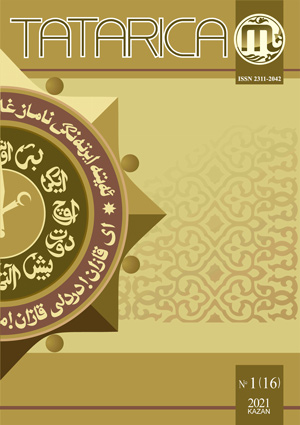
The “Tatarica” Journal has been published in printed form in English, Tatar and Russian by the Institute of Philology and Intercultural Communication at Kazan Federal University since 2013. It publishes the works of Tatar humanities scholars from all regions of the world and other pieces of research, corresponding to the goals and objectives of the journal. We also provide detailed information about the activities of all prominent Tatar scholars, regardless of their scientific interests.
The Journal is registered with the Federal Service for Supervision of Communications, Information Technology and Mass Communications. Its registration certificate PI is No. ФС77-55800 dated October 28, 2013
The materials of the journal are posted on the website of the Scientific Electronic Library and are included in the National Information and Analytical System of the RSCI.
The Journal is included in the EBSCO Publishing Database.
The Journal publishes scientific articles containing research results in the field of language, literature, history, culture, art and education of the Tatar people, as well as bio-bibliographic materials about leading Tatar scholars and the researchers who addressed Tatar issues in one aspect or another, giving brief information about scientific events of the Turkic world.
A feature of the journal is the past and the present of the Tatars in connection with the development of world civilization, the Muslim world, Turkic peoples, Russian civilization and neighboring peoples. On the one hand, the Tatar tradition is seen as a creative interpretation and use of the European (especially scientific) tradition; on the other hand, it is the transmission of knowledge, the analysis of materials and familiarization of Europeans with the peoples of the East.
The “Tatarica” Journal has a very representative and authoritative International Editorial Board, which includes such world-famous scientists as Nazarbayev University Professor Shamiloglu Yulai (Kazakhstan), Harvard University Professor Sunyaev Shamil Rashitovich (USA), Aegean University Professor Oner Mustafa (Turkey), Head of the Turkish Language Department at Gazi University Yakydzhi Ali (Turkey), the University of Maryland Professor Sagdeev Roald Zinnurovich (USA), the Mediterranean Institute of Neurobiology Professor Khazipov Rustem Narimanovich (France), Abai Kazakh National Pedagogical University Professor Khairullin Grif Timurzagitovich (Kazakhstan), Head of the Modern Turkic Languages and Literatures Department at the University of Firat Professor Alkaya Erzhan (Turkey) and others.
Current issue
LANGUAGE
Based on the experience of the Oriental Department of the Eastern Pedagogical Institute in Kazan, the article examines the history of the Tatar national higher education emergence. The material in-cludes articles by its teachers and students, published in the socio-political and literary journal “Yash pedagog” (1926–1929). It was precisely this journal that united the active core of Tatar teachers and students and stimulated the “revitalization” of the Tatar Department. The article analyzes the existing sources and reconstructs the history of the pedagogical education nationalization. We systematize in-formation regarding measures, taken by the authorities and individual teachers to develop the Tatar language as a language of instruction in higher education, and the role of student initiatives in this process.
The Kazan State Pedagogical Institute (University) (1876–2011) was one of the oldest higher education institutions in Russia. It was opened by royal decree as the Kazan Teachers’ Institute after the St. Petersburg and Moscow Teachers’ Institutes. The article is devoted to the history of Tatar language textbooks for schools, written by the methodologists from the Kazan State Pedagogical Institute whose name changed 8 times in its 150-year history. The textbooks had gone through the stages of change and development before reaching the format used and known today. Therefore, in order to fully clarify the problem, which has not yet been specifically studied in the scientific and methodological field, we decided to start the work with its origins –with handwritten dictionaries, phrasebooks and ABC books. In this regard, the focus of the research is on the changes, occurring in different periods of time in the economic, political, cultural, and educational spheres, that had an impact on Tatar language learning. The object of the research is the analysis of the methodologists’ scientific and methodological work in this field; the subject of the research is the study of handwritten dictionaries, phrasebooks, textbooks and other teaching aids with the aim to identify their main features and make suggestions concerning their importance in Tatar language teaching.
The article examines the problems of the structure and content of the Tatar language textbooks in the historical aspect to note their role in solving cognitive, communicative, moral, and aesthetic problems. We substantiate the necessity of creating a new generation of modern Tatar language textbook.
LITERATURE
This article examines the reception of the texts, written by the classic Soviet Tatar writer Khadi Taktash (1900–1931), in the works of the Kazan Pedagogical Institute alumni, as well as in literary and methodological research by the Institute scholars. The chronological framework of the study covers the period of 1922–2026. The article shows that the faculty’s research was conducted within the culturalhistorical school founded by G. Nigmati. While examining the reception of Khadi Taktash’s texts in the works of the Institute alumni-writers, we identified a corpus of texts belonging to various genres (poems, verses, opera librettos, essays, articles, and memoirs). Our study revealed the reception specifics of Khadi Taktash’s texts in Tatar literature at the figurative, thematic, genre, and motif levels.
Chulpan Zarif is the literary pseudonym of poet Chulpan Afraimovna Zaripova-Chetin, a native of the Arsky District in the Republic of Tatarstan. A 1992 graduate of Kazan State Pedagogical University, she is the author of poetry collections “Koyashka yul tota kärvanym” (“My Caravan Walks towards the Sun”, 2003), “Orange Autumn” (2013), and “Lacivärd Yuxular” (“Blue Dreams”, 2023). She creates poems in Tatar, Russian, and Turkish. Love lyric poetry predominates in her work. Chulpan Zarif’s poems have been translated into English, Azerbaijani, Bashkir, Turkmen, Chuvash, and other Turkic languages. The study identifies the factors that have contributed to the development of Chulpan Zarif’s bilingualism and artistic techniques.
HISTORY AND SOCIETY
This article was written on the centenary of the Department of Tatar Language and Literature at the Kazan Eastern Pedagogical Institute. This paper focuses on the Department founders’ activities and on the scholars who continue their work in modern conditions. We studied and evaluated their contributions to the scientific research, to teaching of the national language and literature, and to training specialists in the field of education.
The article describes the development of scientific schools, formed at the Department in different historical periods, their main fields of study and achievements, and demonstrates the contributions that our prominent scholars have made to the history of Tatar literary studies.
This work is aimed at establishing a connection between the past and present of the Department of Tatar Literature, preserving and further developing national education traditions.
In this article, we summarize the experience of many years of fruitful work, devoted to training teachers in the field of the Tatar language and literature, conducted at the Kazan State Pedagogical Institute. The aim of this higher education institution was to prepare teachers not only for the Republic, but also for schools in regions with a compact Tatar population, so it successfully fulfilled its historical mission for more than a century of its existence, becoming the main training centre for national teaching staff.
The main purpose of this scientific article is to highlight the work of this Institute, located in the centre of Tatarstan. The work was performed in close cooperation with a number of pedagogical institutes in other regions and included the exchange of methodological manuals and teaching staff, which greatly contributed to the effectiveness of teacher training.
The message of the article is to highlight the close cooperation that existed between the Kazan Pedagogical Institute and the Tobolsk Pedagogical Institute, located in remote Siberia, and the historical essence of this cooperation; to evaluate the great work of the scientific and pedagogical personnel sent to the Tyumen Region in different years to train teachers for national schools in this part of the country, to create a national education system, and to contribute to the preservation of the Tatar language and national culture.
CULTURE, PERSONALITY, EDUCATION
This article studies the formation and development of the Mizgel Student Theatre, established at Kazan State Pedagogical University on the initiative of its Rector R. G. Yusupov in 1996. The article explores the role of theatre pedagogy in developing creative abilities of students – future teachers of the Tatar language and literature. This study systematizes information about the “Mizgel” Theatre’s repertoire and analyzes the working principles of its directors: Marsel Zabbarov, Fanuza Gabdrakhmanova (Khasanova), Leysan Shayakhmetova, and Ilfak Khafizov. This information was obtained by analyzing reviews, reports, and promotional materials published in the media, and the interviews with the theatre’s directors and actors.
The article systematizes material on the history of teaching Tatar literature methodology at schools, based on the experience gained at the Kazan Pedagogical Institute (in various periods of its history it was named the Eastern Pedagogical Institute, the Kazan State Pedagogical Institute / University, Tatar State Humanitarian and Pedagogical University). The study reveals the contributions of the Tatar Literature Department to this work, identifying the key developers of the programs and textbooks for schools, and the trends of their scientific research.
The chronological framework of the study covers the period of 1920–2011. The article proves that the University work in this area was carried out in several aspects: the development of programs on Tatar literature, the creation of school textbooks based on them, the preparation of teaching manuals and aids for teachers, the publication of teaching-methodological sets, the writing of textbooks for secondary and higher education institutions. The novelty of the study is the first systematic monographic study of the topic.
PERSONALIA
Nigmetzyanov Makhmut Nigmedzyanovich (1930–2020) was a musicologist, teacher, and candidate of art history (1972). From 1953 to 1958, he studied at the Kazan State Conservatory in the Faculty of Music Theory and Composition. From 1960 to 1967 and from 1974 to 1984, he was a research fellow at the Institute of Language, Literature, and Art, the Kazan Branch of the USSR Academy of Sciences. From 1967 to 1973, he was the Artistic Director of the Tatar Philharmonic.
In 1972, he defended his dissertation for the degree of Candidate of Art History “Musical and stylistic features of the Middle Volga Region Tatars’ traditional folk song.”
From 1984 to 2003, he was the head of the Department of Tatar Music and Folk Musical Instruments and professor (from 1990). He was a collector and researcher of Tatar musical folklore and a compiler of folk song collections. He was the author of research works on Tatar musical culture, theory, and history of music, an Honored Artist of the Tatar ASSR (1979) and a Laureate of the State Prize of the Tatar ASSR named after G. Tukay (1985).
Bakir (Bakirov) Gosman Fathullovich (1896–1982) was a writer and an Honored Worker of Culture of TASSR (1966).
He graduated from the Kazan Land Construction Technical School, the Workers’ Faculty of the Eastern Pedagogical Institute, the faculty of Literature and Art of the Moscow University (1930–1931), the Kazan Pedagogical Institute (1940). In 1929–1937, he was an executive editor of “Magarif” journal, in 1940-1942 – an executive editor of the Educational and Pedagogical Literature division of the Tatar State Publishing House.
He was a participant of the Great Patriotic War. In 1945–1956, he was the head of the Educational and Pedagogical Literature Department of the Tatar Book Publishing House. He was the author of collections of plays, novellas, and short stories for children. He died in Kazan on March 12, 1982.
Kadyrov Ilgiz Khanovich (1931–2013) was a historian, an educator, and a public figure.
Born in the village of Novye Chelny, the Alkeyevsky District in the Tatar ASSR, he graduated from the History Department of the Kazan State Pedagogical Institute (1949–1953) and completed his postgraduate studies at the Moscow State Pedagogical Institute named after V. I. Lenin (1964–1967).
He received the degree of сandidate of history (1971) and was a secretary of the Komsomol Committee of the Kazan State Pedagogical Institute (1954–1960). First, he worked as assistant (1954), then, as associate professor (1973) in the Department of General History at the Kazan State Pedagogical Institute.
From 1988 to 2008, he was Head of the Department of General History at the Kazan State Pedagogical Institute. Ilgiz Kadyrov was the author of works on modern history of Asian and African countries and the works on the content and methods of teaching history at universities. He was awarded an Honorary Diploma of the Presidium of the Supreme Soviet of the Tatar ASSR (1958) and Honorary Diplomas of the Tatar Regional Committee of the CPSU and the Council of Ministers of the Tatar ASSR. In 1992, he got the title of an Honored Cultural Worker of the Republic of Tatarstan.
REVIEWS
This review presents a critical analysis of a monograph, devoted to the development and transformation of the education system in Tatarstan in the first half of the 20th century. The reviewer highlights the work’s strengths: its broad source base, interdisciplinary approach, and detailed reconstruction of educational processes in the context of socio-political changes. Particular attention is paid to assessing the author’s conclusions regarding the influence of national policy on the development of the school network and teaching staff in the region. The book is intended for historians, educators, and researchers studying issues of regional educational policy.
The article reviews Academician R. Yusupov’s books published over the past five years, briefly highlighting and evaluating their topics and problems. We show the contributions the scholar has made to the study of modern Tatar speech culture and its development as a scientific discipline.
Naki Isanbet as a writer and scholar stood at the origins not only of Tatar literature, but also of Tatar folklore. The “Tatar myths” collection, prepared for the publication, can be rated as one of the best in Tatar folklore. Although the manuscript was handed over in 1990, it was never published. The compilers of this book were unable to trace it, so the scholar's work had to be reconstructed from drafts, notes, and published works. Naki Isanbet's "Tatar Myths" is being introduced into scholarly circulation for the first time.